
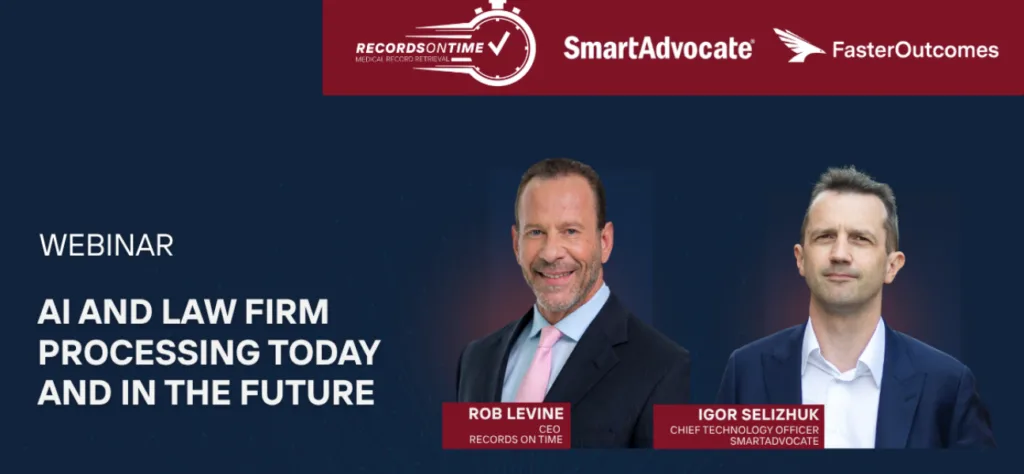
Did you miss our latest webinar on AI in personal injury law? Here’s your chance to catch up on everything you need to know.
Meet the Speakers
Rob Levine is the owner of Rob Levine Law, a personal injury firm of roughly 400 people serving Rhode Island, Massachusetts, Connecticut, and New Hampshire, with a nationwide Social Security and veterans disability practice, and a recent expansion into workers compensation in Rhode Island and Massachusetts. Rob also owns Records On Time, a medical record retrieval company built to integrate seamlessly with SmartAdvocate, and is a part-owner of FasterOutcomes, an artificial intelligence platform designed to work together seamlessly with your case management system.
Igor Selizhuk is the CTO of SmartAdvocate, where he leads the development of the platform’s growing suite of AI capabilities. As the mind behind SmartAdvocate’s AI roadmap, Igor brings a rare inside view of how AI is being built directly into the tools attorneys and law firms already use every day.
Together, Rob and Igor hosted an open, conversational webinar about where AI stands today, where it’s headed, and what personal injury firms need to know before diving in.
The AI Conversation At a Glance
Rob and Igor kicked things off with a candid conversation about the state of AI in legal practice: it’s not going anywhere, it’s not going to replace your team, and it’s not a magic fix for a firm with shaky operations. Correspondingly, they went through the entire lifecycle of a case, from intake through case-building, medical management, and beyond, showing exactly where artificial intelligence is already helping firms today and where it’s headed next.
Along the way, they answered the questions that came in from viewers and that most lawyers are probably wondering: How do you protect client PHI when using AI tools? What belongs in a fee agreement? Can you pass AI costs, especially those for drafting demand letters, on to clients? And what’s the real difference between using an all-in-one platform versus building your own custom AI workflows?
They closed the conversation with a look at where the legal industry is heading — from private equity’s growing role in law firm consolidation to AI’s expanding footprint in marketing, HR, and finance — and a clear, shared message: firms that don’t start using AI now risk falling behind.
What Will You Learn from the Webinar?
- Why AI is transforming legal practice without replacing your team and how to change the thinking from worries about job security to looking for efficiency gains
- The PHI risks of using public automated intelligence tools like ChatGPT, Claude, or Gemini, and why enterprise or integrated platforms offer a safer path
- What the ABA’s model rules say about AI use and client consent and how to update your fee agreements accordingly
- Where it’s appropriate, and where it’s risky, to pass AI-related costs on to clients
- How AI-powered intake tools can support your staff without replacing the human connection clients expect
- How artificial intelligence can catch details in a case that a human might miss, such as DRAM shop liability in a car accident to building code violations in a slip-and-fall
- How AI medical chronology generation works, and why human review is still essential
- What a firm-wide “knowledge system” is, how it helps agents cross-reference new cases against your firm’s history, and how that benefits your firm
- The future of automated intelligence: proactive case review, causation-building for complex medical claims, and analyzing client communications for early warning signs of dissatisfaction
- What SmartAdvocate’s new MCP server integration means for firms that want to build custom AI workflows
- The difference between SmartAdvocate’s core and advanced AI tiers, and what each includes
- Why AI adoption is becoming a competitive necessity, especially if your firm is considering private equity investment
Want all the details from the full conversation? Watch the complete webinar recording below to hear Rob and Igor’s insights firsthand.