Welcome to Lawyer Business Advantage.
This podcast is dedicated to helping
attorneys earn more money, get better
clients, and spend more time with
family. I’m your host, Alai Yajnik,
founder of Law Firm Success Group. Smart
business guidance for small law firms
begins in 3 2 1. And it’s my pleasure to
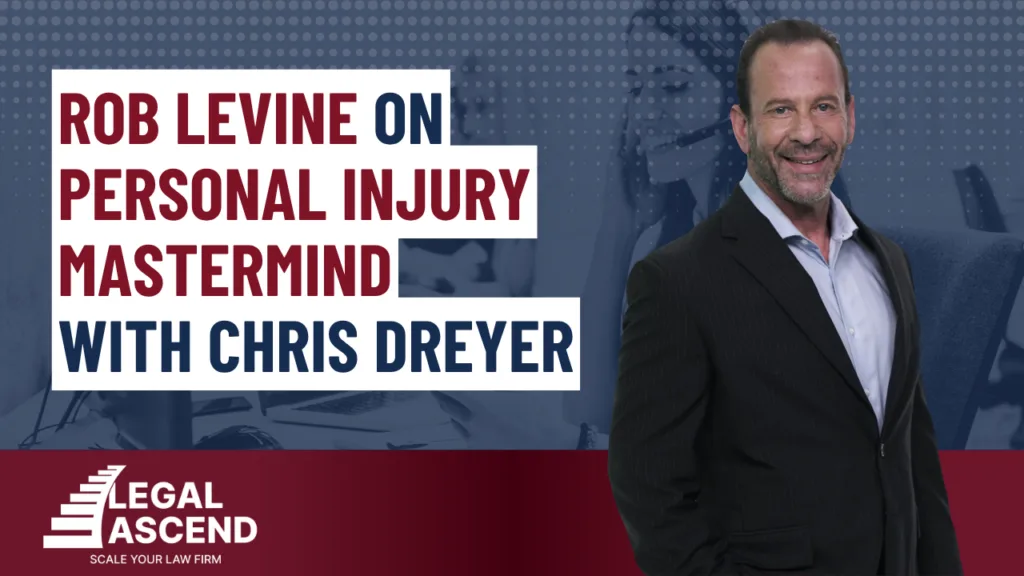
welcome to lawyer business advantage Rob
Lavine with Rob Lavine Law and Rob
Lavine Legal Solutions. Rob, welcome to
the podcast today. Olay, thanks for
having me. I appreciate it. I am always
excited to get someone on the show who
not only owns and has built a successful
law firm, but also helps other attorneys
do the same. So, tell us a little bit
about your law firm and the legal
solutions you offer. Absolutely. So,
I’ve been a lawyer for 25 years. Uh, I
think when I first started practicing,
we did probably a little bit of
everything. Uh, just I graduated, hung
my own shingle. Uh, I was actually
in-house counsel to a plumbing and
heating company. Uh, I did their
accounts receivable. I did contract law.
Uh, I was on their executive board. We
grew them from 50 people to 300 people,
from 5 million a year to 40 million. So
that’s really where I got my business
sense and and first wet my feet in
business training. And then slowly as
the law firm grew, uh we niched it down
to really first was personal injury law
and title and closing. So we did title
and closing business really all over the
country. Uh and this was pre208. We were
doing subprime mortgages. And so then
when the mortgage crisis happened in
’08, uh we added in social security
disability. So we were growing the
personal injury business and social
security and then we added in veterans
disability. So really the three things
we do are personal injury that’s in
Rhode Island, Mass, Connecticut uh and
New Hampshire now. Um and then we do uh
social security disability and veterans
There’s a lot of attorneys that really
struggle to grow their law firms and
you’ve not only developed a strong niche
in one practice area, but now you’re
actually I think at three. So, what are
some of the things that you think you
may have done differently may or maybe
had a different mindset than other
attorneys that are struggling?
I think the most important thing to
remember and one of the things that we
certainly teach in our mastermind group
or if I’m doing consulting is a law firm
is no different than any other business
and right so you are running a business
that happens to be in the practice of
law and what I often see in small law
firms midsize and sometimes even in
larger law firms is that the owner we’ll
call them CEO is really engaged in the
practice of law every day. And so if
you’re a small law firm, obviously you
have to be practicing law. But there’s
that sliding scale where you have to put
some time into the big picture, the
vision, right? So as the CEO, you’re the
visionary. It’s your decision to decide
first of all, what’s my goal? Do I want
to be a bohemoth? Do I want to be a
boutique law firm? Where do I want to be
in a year from now, three years, five
years, 10 years? And as you’re scaling,
you start to slide that meter across
from maybe it’s 1 hour a week to 5 hours
a week to 10 hours a week. And you keep
spending more time focused on the
business, less time on the actual
practice of law. It’s either that or you
have to bring in a CEO and someone who’s
going to help you scale and grow your
business. If you want to practice law
full-time all day, your business will
never grow unless someone is focused on
the bigger picture. Yeah. It’s it’s
interesting because when you think about
most other businesses, this wouldn’t
even really be a concern. I mean, you’re
bringing in, you know, it’s a business
and you treat it like one and you run it
like one, but attorneys aren’t trained
to run businesses and they don’t
necessarily think when they open up a
law firm that they are now putting on a
CEO hat. They often have this uh mindset
of look, I’m a practicing lawyer. I’m
going to hang out my shingle, do great
work for my clients. I’m going to, you
know, bill out my time and I’m going to
make money that way. And as long as they
way, they’re always going to be stuck in
that in that rut. And the the point you
mentioned, I think, is so important
because so few attorneys think about
doing this, which is being intentional
and thinking about the law firm you want
to have. you know, what is your vision
for the firm? Because once you establish
that and you figure out what you really
want, then it becomes so much easier to
figure out what the roadmap is to get
there. Totally agree. And it’s really
not just law firms, it’s any service
business, right? So, if you’re
leveraging your own time in the
business, you’re going to stunt your
growth. So, you have to figure out how
to leverage other people’s times. bring
people in who can do the actual
operation of the business. Whether
you’re a mechanic, whether you’re a
hairdresser, whether you’re a lawyer, a
doctor, if all of your time is spent on
the service and not on the business,
then you’re going to end up being just
that service. Yeah, it’s that whole
E-Myth concept or better book is the
E-Myth Revisited, but this idea of as an
entrepreneur, you spend all your time in
the business, not on the business. And
that’s now become a very trit kind of
saying, but it’s incredibly powerful and
incredibly true. If you’re going to
spend all your time, if you’re a
shoemaker making shoes, you know,
cobbling shoes, then you’re not going to
be able to really grow your business
beyond that, and you’re going to be
doing a lot of work along the way. So,
tell us a little bit about this
transition to, you know, building a
successful law firm and then now
offering solutions to attorneys to help
them do the same. What drove you to make
I think it was just kind of a natural
transition over time because as the law
firm grew and we’re now 235 people we
open we’re just about to break a
thousand cases a month. I’d say within
the next 3 months we’ll be over a
thousand cases a month. And so as we’ve
grown, so for instance, record
retrieval, probably 15 years ago, we
decided to build our own record
retrieval company to service our law
firm. Rather, first of all, we tried an
outside record retrieval service. It was
a horrible experience. Using your own
internal team, your case managers or
parallegals to do record retrieval is
expensive. They’re not focused on the
right things. they should be focused on
value and growth of the case, not on
administrative tasks. So, we built one
for oursel and then as time went on,
people asked me, can I help them? Can we
do it for them? And I just decided at
some point that this just makes sense
that we should build the platform not
just to service our law firm, but to
service other law firms as well. I love
that. So, what do you do with that
service? I’m not familiar with it.
So, if you obviously do either mass
tort, personal injury, medical
malpractice, anything that requires your
clients needing you to collect their
medical records and bills for them,
that’s our job. So, law firms across the
country hire us to collect their medical
records and bills. And so the typical uh
record retrieval service, you have to go
into their platform, you have to enter
your client’s information, you have to
go back and pull down records, then you
have to download the expenses, put it in
your system. We’ve created a platform
that has bilateral communication. So we
literally come in to your system every
hour and we pull your client’s
information, we pull the HIPPO form, and
we pull the provider information. Then
our team goes out, collects the records,
brings everything in, ensures it’s
accurate, gets OCRs, it, compresses it,
and then we literally push it back into
the document storage system of the law
firm. We push all of the expenses and
costs into the expense tab, and then for
seamless communication, all of the
conversations and emails are turned into
tickets, and then those are pushed into
the case management system in the notes
tab. So they have a record of everything
that we’re doing. And the average record
retrieval, if you you process mapped, it
takes 16 steps. If you hire us, you do
three. Talk to your client, enter it
into your system, and drop in your HIPPO
form. The other 13 steps we do
seamlessly for you, and you don’t ever
have to worry about it. So, better,
faster, cheaper. Love it. Exactly. And
it’s cheaper because it’s an outsourced
service. So, you can pass our client,
our fee on to the client. So, it really
we’re saving you time and money and it’s
completely free for the law firm. It’s a
no-brainer. Great. Great. Well, we’re
going to talk a little bit more about
how people should get in touch with you
when the time comes because I’m sure a
lot of our listeners would be interested
in that. But you also do legal staffing
as well, and there’s a lot of um you
know outsourced legal staffing and
training companies that are out there.
Um tell us a little bit about uh that
service. Sure. So, you’re correct that
there are definitely um a tremendous
number of companies internationally that
you could hire and have them place
someone in your office. No one is doing
what we do. So, we run an academy that
actually trains and certifies a case
manager to run uh a personal injury case
from start to finish or what I call
cradle to grave. So, they go to a
12-week academy full-time, 5 days a
week, eight hours a day. We have about a
20% wash out rate because we set the
standard that you expect when we place
someone in your law firm. And if they’re
not going to meet that standard, we’re
not going to place them. And so they
literally learn how to run cases from
start to finish. Uh and you don’t start
paying as a client until I actually
place them in your law firm. So I train
them on my dime and then I place them in
your law firm. Awesome. That’s great.
May I ask how you got that connection,
that international relationship that
you’ve built? Yeah. So in 2020 when we
had COVID uh when COVID first hit, we
were about a 100 person law
uh we were concerned because no one knew
how long COVID would last. Obviously you
can’t have a personal injury case if
you’re quarantined to your house. So we
laid off 25% of our team. So we went
from about 100 people to 75 people. and
we immediately recognized that we still
have thousands of cases that we have to
keep running. And so we decided to hire
internationally. And so we did a study,
figured out where we wanted to be.
Colombia and Peru made the most sense
for us because it’s like a one-hour time
zone change, right? Um they’re speak
English very well. Yeah. Yeah. So
they’re bilingual, so we have obviously
a large uh Hispanic population. So that
worked fantastically for us and it just
has grown from there and so the law firm
now we were 100 we’re now 235 people uh
and then we’ve placed hundreds of people
around the country so it’s just going
One of the things that I always wonder
about with PI firms and all contingency
type of firms is cash flow as especially
as you’re getting started. I mean,
you’re at at the point now where it’s
probably not as much of an issue, but
when you were getting started and
driving your growth, um, how did you
manage uh the lumpiness of the cash that
So, I mean, cash flow is always an issue
because we’re always in growth mode. So,
for instance, we just entered the Boston
market. So, we’re number one in our
market in Rhode Island. We’ve been in
Boston now since uh the beginning of the
probably five to 10 times the cost of
the market we’re in. And so, you know,
it takes 12 to 18 months to turn a case
from signing someone to uh receiving
fees. So, when you’re paying for the
marketing upfront, you’re paying for the
staffing increasing upfront. Totally
agree with you. So, for us, it’s lines
of credits at this point. So, we we use
lines of credit for growth. when we were
smaller, we had smaller lines of credit.
Uh, and it’s just, you know, internal
funding, proper planning. It’s just
you plan where you are, where you want
to be, create projections, and then
track month over month. What did I plan?
What did I hit? What went right? What
went wrong? And making sure that you’re
going to be able to deliver. That’s
where I think we see most law firms who
come to us for help struggling. They
don’t really first of all set the goal.
They don’t create the projections and
the plan. Um, and then they haven’t come
up with the answer to that question
because you have to be able to carry it
long enough for it to start to pay back.
And if you’re always scaling, right, and
you’re always feeding that marketing
funnel and trying to keep grow, you
chase it forever. So you have to make
sure that your growth rate doesn’t out
outpace your revenue and your profit
because you have to make money. So it’s
finding that fine balance and really
knowing your numbers. Yeah, for sure.
And that’s not something, you know,
going back to our earlier point that an
attorney can do if they’re working in
the business all day long. Like this is
when you think about growth, you’ve got
to be able to take a step back and think
about your financial projections and
your risk tolerance and how you’re going
to bring on the debt and all those
things. I’m just actually hitting an
interesting inflection point in my
business. It’s probably something you’ve
a long time ago. But it’s um it’s a
mindset shift. I went from thinking
about oh my gosh you know how am I going
to get the money to fund XYZ growth
initiative that I wanted to do and um
past I don’t know 3 4 months um that
shifted and I now recognize that there
is plenty of money out there like if you
have a decent bit especially a law firm
which is high margins very profitable
bonus if you own your own building but
you can get money you know it’s Not
actually that hard, right?
That’s true. Um especially now, so you
have shared services models. For
instance, you can have one business in
Arizona, your law firm somewhere else.
Uh and you can take private money that
can loan money into your shared services
model. If you run a law firm in Arizona,
you can certainly take money from other
partners. A law firm in Florida, for
any other state can’t actually share
profits or take money and pay profits
out of a law firm. But when you create
the shared services model, right, all of
the parallegals, the finance, the HR,
whatever services that are non-legal,
you can certainly borrow money and then
pay through the shared services model.
There’s lots of ways to do it today.
Yeah, lots of ways to do it. And that’s
where having um you know that time to
really think about how do you want to
run your business and then tapping into
something like a mastermind group where
you’re talking to other attorneys who
have been dealing with the same problems
you have and are trying to figure out
solutions together. And so you’ve been a
member of a mastermind for a long time.
You’re now running your own mastermind
groups. Tell us a little bit about how
that works. So yeah, I probably first
joined a mastermind group maybe 18 years
ago, I’d say, right? I’ve been a lawyer
for 25 and I’ve been in a lot of
different mastermind groups and have met
a lot of fantastic people that certainly
have contributed to helping me get to
where I am. No question. And so part of
enjoying having my own mastermind group
is being able to give back and help
others. And so we’ve really structured
our mastermind group differently than
the typical. So typical mastermind group
is you have maybe two in-person meetings
a year, maybe three, and that’s it. And
so it’s hard to go to a seminar,
conference, summit, and grab that
information and then come back to your
law firm and be able to implement it,
right? It’s easy to learn at the summit,
but it’s hard to transition, come back
to the real world, and then take that
and implement it. Yeah. Because the
follow through and accountability is
missing, right? You you get all these
great ideas, you come back, and then
boom, reality hits like a hammer and
Exactly. So we created weekly Zoom
meetings. So the first week of the month
is goals and accountability. So we have
your setting projections. We have what
your goals are and we’re holding you
accountable towards focusing on that
growth and what you’re working on. The
second and fourth week of the month, uh
we have breakout rooms. So you could be
in a room on intake. You could have a
subject matter expert every week that’s
on operations or on marketing. Those are
the big three that are consistent all
the time. And then we rotate in HR, we
rotate in training and onboarding, we
rotate in IT. So whatever it is that
your firm needs that you want to focus
on, we have a subject matter expert
who’s in the room ready to teach, answer
questions, plus you have all the lawyers
sharing together. It just creates a
fantastic group of energy for everybody
to be able to learn from. And then the
third week of the model. Yeah, thank
you. The third week of the month is hot
topics. So it it varies. This this week
um we’re doing creating a consortium for
everybody to share together if they want
to invest in mass tors or using the
buying power with vendors. So we every
month is a different topic that’s uh
useful for everyone. And then two
inerson meetings a year and then are
they only is it only PI firms or all
types of firms? Uh we have one it’s
mainly all PI. I have one lawyer who’s
um really catastrophic property damage.
Um but for the most part it’s all PI.
All PI. Yeah. We actually launched our
mastermind groups in January and uh the
one I’m really excited about uh
different from yours. Um we meet once a
month on Zoom and then uh that’s about
an hour and a half and every agenda is
different. The group brings a lot of
issues to the table. There’s
conversations facilitated. There’s
action items that are taken away. Uh and
then they report back on those action
items at the next meeting. in between uh
they have a one-on-one conversation uh
with the facilitator of the group. Um
the facilitator is not a lawyer. So um
that drives a lot of interesting
engagement and we’ve been seeing some
really good initial results with it.
It’s it’s a little um I don’t know
humbling because uh I built my practice
on one-on-one coaching. So to, you know,
do that and have that experience and
then to see lawyers really getting a lot
of benefit out of talking with each
other is like, oh my gosh, where’s my
value? Um, but it’s it’s a lot of fun
and they’re having really good results.
So I love the model you’ve come up with.
Thanks. Your sound is great. Yeah, it’s
it’s it’s fun and there’s so many
mastermind groups out there. It’s
important to find the right one. And so
who would you think would be, you know,
apart from being a PI attorney, are
there other things you look for as
someone that would be a good candidate
really it’s just someone who has a
growth mindset right so if you’re really
im interested in growing improving your
process um changing the way your
operation is going anyone who wants to
implement change growth scale I think
they’re a good fit we have small law
firms in the group and law firms up to
100 200 uh team members in their group
so all different sizes which is nice
because everybody brings a different
mindset, unique issues, and everybody’s
able to be able to help each other. So,
it’s kind of cool. Yeah, it’s it
certainly is. And if people are
interested in connecting with you, Rob,
um whether it’s for medical record
retrieval or legal staffing or the
mastermind group or a PI case, uh what’s
the best way for them to do that? My
email is simple. It’s my name. It’s
Great. and what are some things that
you’re excited about whether it’s for
your law firm or for the legal solutions
uh company you have over the next year
or so? So the most exciting thing is uh
the what I see as the future um of not
just law firms but business in general
and where we’re going and that’s with
the advent of AI. And so I just became a
partner in an AI company called Faster
Outcomes. And so the the brain power
behind that organization, the the the
team members that are there and the
vision of how we create something that
we’re talking about that’s going to be
called knowledge, which is going to be
able to take all of the information in
your law firm and ingest it into the LLM
model, right? The large language model,
a closed model, and integrate it
eventually to your case management
system. So it knows everything, the
letters that you use, the research, the
medical, and use that model to be able
to grow the value of your cases, manage
your cases, investigate your cases,
properly address the issues that come
up, and ask your office assistant, hey,
I need to do this on this case, or it’s
telling you, you dropped in your medical
records and it did a chronology, and
it’s telling you, this case has a
potential TBI. you should be considering
this and this and this or this case has
a potential herniated disc and the next
step should be this. So AI is is going
to change the way we do everything. It’s
going to just change how we use our
labor team, how we address clients, how
we handle cases. That’s the most
exciting thing I’m looking forward to.
That sounds awesome. Congrats on joining
that firm. Congratulations on all your
success, Rob. And thank you so much for
being on the show today. Thank you.
Thanks for having me. I appreciate it.
And that’s a wrap for this episode of
the Lawyer Business Advantage podcast.
One thing that would really help both us
and other new potential listeners is for
you to rate this show and leave a
comment in iTunes, Stitcher, or wherever
you tune in to listen. And I want to
hear from you. So connect with me on
LinkedIn and let me know what you think
of this episode. And if you are a solo
or an owner of a small law firm and
you’re looking to earn more money,
attract better clients, or reduce your
stress, we would love to talk with you
to see how we can help. Request your
free law firm assessment by visiting law
firmsuccessgroup.com. Again, that URL is
lawfirmuccessgroup.com. We look forward
to talking with you soon. Thank you for
listening. My name is Al Yajnik. Until
next time, remember you can seize
freedom, you can embrace happiness, you
can build your perfect practice.