

You may have reluctantly accepted that provider fees are simply part of the deal when requesting medical documentation to build your clients’ cases. The release of medical records does come at a cost, but those costs can be reduced if you know which records to request. Digital medical records called electronic health records (EHR) can give you the information you need without the fees you’re used to paying.
What Is the Medical Record Retrieval Process?
Medical record retrieval follows a set process: identify the client’s providers, get the client’s authorization, request the records, track the request, and deliver the records once they arrive.
For traditional requests, providers typically charge a fee. Some want payment up front, and others bill afterward. Many retrieval vendors pay these fees as they come up and pass the cost on to your firm, so requests keep moving without your team having to track who needs payment when.
HIPAA’s Role in Third-Party Retrievals
The Health Insurance Portability and Accountability Act (HIPAA) controls how healthcare organizations protect medical records and when they may release them. A law firm can request a client’s records with the client’s signed authorization. Some records have extra protection. Psychotherapy notes and certain substance use disorder records require additional authorization or are subject to stricter federal rules.
HIPAA treats patient requests and third-party requests differently. When patients request their own records, HIPAA sets a 30-day response deadline and limits what providers can charge. Neither rule applies to third-party requests such as those from law firms. For those, response times and fees are generally set by state law.
How Much Are Provider Fees Per Retrieval?
There isn’t a specific fee that applies to all providers. Provider fees are decided by the provider within limits set by the state in which it practices. Providers can charge fees for reasonable costs including:
- Per-page copying
- Search or retrieval
- Postage
- X-ray or media reproduction
- Certification costs
Each medical practice decides what it will charge for and how much those fees will be within the limits of state law. This results in different provider fees for different providers. Additionally, because most providers charge per-page fees, fees can also vary based on the size of the patient’s record.
Why Do Providers Charge Fees?
Provider fees allow the provider to recoup the administrative and operational costs associated with the retrieval and release of medical records.
Pulling records requires dedicated staff time to review authorizations, search the archives for the records, verify the patient’s identity, and redact or format the records. Retrieving patient medical records can also involve supplies and materials such as paper, toner, CDs, USB drives, and postage. Some healthcare organizations outsource record storage and pay third-party vendors a fee to maintain a secure portal and process external requests. These can all be included as reasonable costs.
How Can You Avoid Provider Fees?
One way to avoid provider fees is to request electronic health records (EHR), which are often confused with electronic medical records (EMR). While both are digital medical records, they are not the same.
It is important to know how to get medical records with no fees, and that starts with requesting the right type of record. Our retrieval process defaults to requesting EHRs when they are available. EMRs, on the other hand, are retrieved using the traditional method that is used for paper records and does not avoid the provider fee.
EHR retrieval is available for providers in our direct EHR network, so some requests will still go through traditional retrieval.
Why Are There No Provider Fees for EHR?
The main reason there are no provider fees for EHRs is that the process does not submit a request to the provider. Instead, we text a link to your client, which they use to grant authorization for us to get their EHR records.
For your team, nothing changes. You will submit your retrieval request as you usually would, and the system automatically goes to work to request EHRs. We send the link, and once your client approves it, we handle the rest. You’ll still be able to track your requests, and they’ll still be delivered straight into your CMS.
What Happens If Your Client Doesn’t Click the Link?
When we send the link, your client has 48 hours to click it and provide authorization. If they cannot or will not, then the request automatically switches to the traditional retrieval method with the accompanying provider fee. One way to encourage a reluctant client to click the link and provide authorization is to explain that avoiding provider fees means more of their settlement stays with them.
How Much Money Can You Save by Switching to EHR?
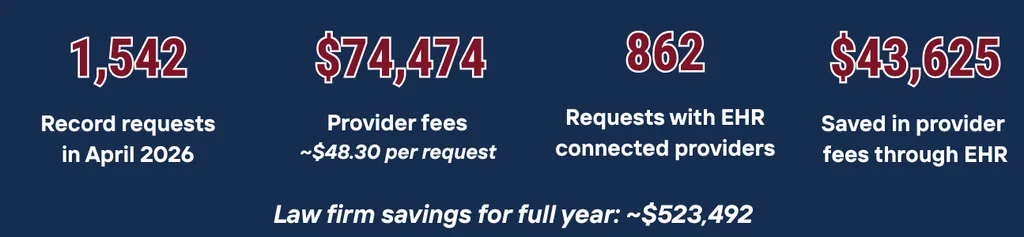
Let’s take a look at an actual firm’s potential savings. Firm A submitted 1,542 record requests in April 2026. All requests were handled through traditional retrieval at the firm’s request, costing $74,474 in provider fees for the month. This is an average provider fee of $48.30 per request.
Of those 1,542 requests, 862 went to providers who are reachable through our direct EHR network. With that connection, the provider fee is $0. If they had opted to use EHR requests instead, they would have paid only $30,850 in provider fees for the remaining 680 requests that required traditional retrieval. They would have saved $43,625 in provider fees that month.
If they continued submitting requests at the same volume, Firm A would save $523,492 in provider fees in one year by switching to EHR requests.
Let Us Help You Save Money
At Records On Time, our top two goals are delivering quick, accurate medical records and saving our clients money. Electronic health records help us accomplish both goals. Your requested records are delivered directly to your CMS in one day, fully OCR’d and ready to use, and you only pay our $49.95 fee. EHR retrieval is HIPAA-compliant and links are encrypted, ensuring your client’s privacy is protected from beginning to end. You can use our Cost Savings Calculator to estimate your savings. Or book a demo, and we’ll walk you through our process and crunch the numbers to estimate how much your firm can save by switching to EHRs whenever they’re available.